
How to Find Recently Released Monmouth County Inmates
Monmouth County does not publish a separate "recently released" list. There is no single page that names everyone who walked out of the jail this week. Release status has to be pieced together from the tools that track custody. The first stop is the Monmouth County Sheriff inmate search, which reflects who is in custody at the Monmouth County Correctional Institution right now. If a person no longer appears there, it usually means they have been released, transferred, or moved to another jurisdiction.
The jail roster is a current-custody tool, not a release log. So a name dropping off the list is a clue, not proof. Someone could have bonded out, finished a sentence, been sent to state prison, or had a case dismissed. To confirm what actually happened, you check the next system in line and then call the facility if the picture is still unclear.
When the online search leaves you guessing, the records line is the fastest way to settle it. MCCI's main number is 732-431-7860. Staff there can confirm whether a person remains in custody or has been released, within the limits of what they are allowed to share. Have the full legal name and a date of birth ready, since common names slow the process down.
- Check the sheriff inmate search first for current county custody.
- Note that a missing name can mean release, transfer, or a case change.
- Move to the state or federal locator if the person left county custody.
- Call MCCI at 732-431-7860 to confirm a release when the data is unclear.
Setting Up Monmouth County Release Notifications
Waiting for a release is stressful, and refreshing a roster all day is not realistic. That is what VINE, the Victim Information and Notification Everyday service, was built to fix. Through VINELink, you can register to get an automatic alert when an offender's custody status changes. The notice can reach you by phone, email, or text where the option is supported. Victims and concerned residents both use it.
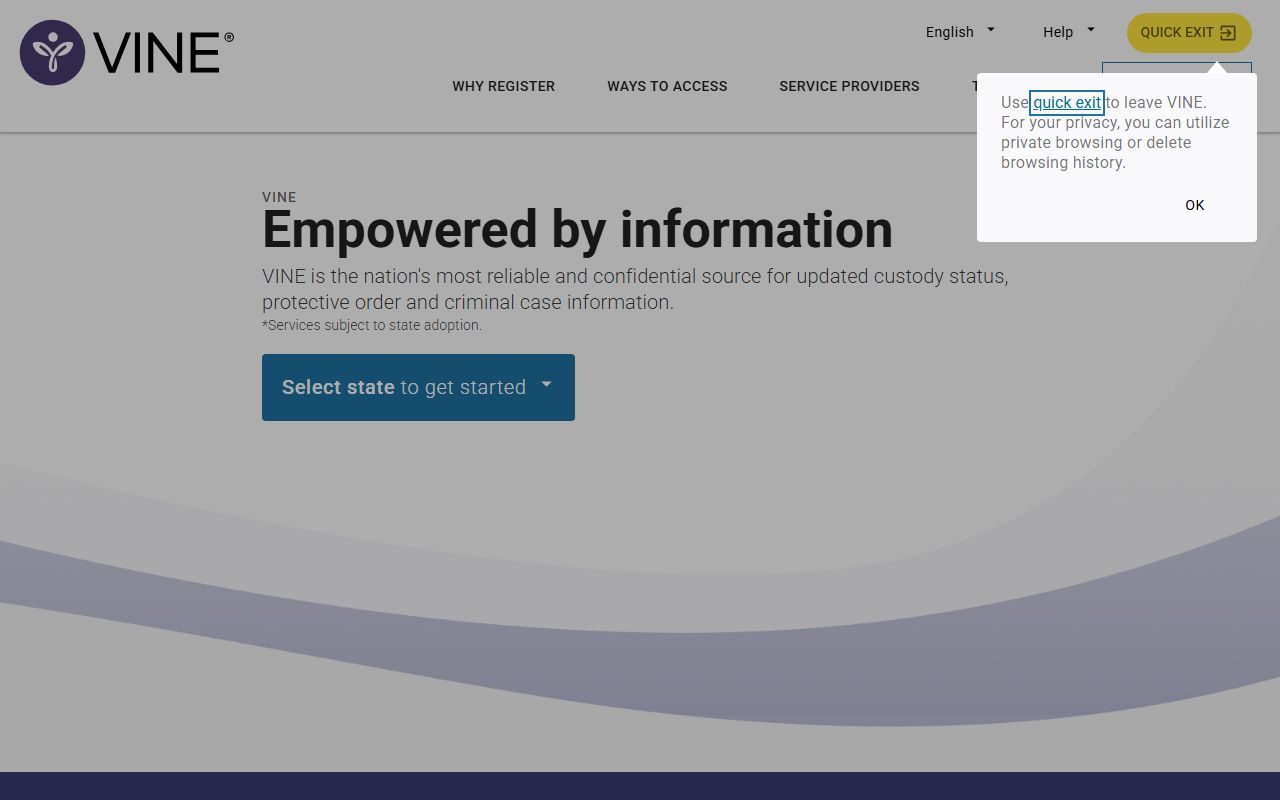
The lead-in screen lets you pick a state and then run an offender search. The image below shows the VINELink custody-notification entry point.
You start by selecting New Jersey, then look up the person by name or ID. Once you find the right record, you choose to register for a notification so the system contacts you on any change.
A lead-in note before the screenshot helps set expectations. The VINELink home page is where the search begins.
After registration, VINE handles the watching for you. The table below lists the search fields the public VINELink offender lookup uses.
| Field Label | Type | Required | Notes / Format |
|---|---|---|---|
| State | Dropdown / map | Yes | Select New Jersey to search state and county data. |
| Name / ID | Text | Varies | State-specific offender search by name or ID number. |
| Facility / location | Dropdown / filter | No | Optional filter; available options vary by state. |
| Register for notification | Button / link | No | Sign up for alerts by phone, email, or text where supported. |
- Open VINELink and choose New Jersey from the state list.
- Search for the person by name or ID number.
- Open the matching record and select register for notification.
- Enter your phone, email, or text contact and confirm it.
Crime victims in the county can also get help signing up. The Monmouth County Prosecutor's Victim-Witness Unit assists with VINE registration and release notification for victims, so a victim does not have to navigate the system alone.
Searching State and Federal Released Inmates
People leave Monmouth County custody for two big destinations beyond release: state prison and federal prison. Each has its own public locator, and each shows a different slice of the picture. If a person was sentenced to a New Jersey state term, the county jail roster will not track them. The New Jersey Department of Corrections offender search covers people held in state prisons, and it is the tool the state parole system itself links to for custody lookups.
The NJDOC search works on a name or an assigned number. Results help you tell whether someone is still serving a state sentence or has moved on to parole or release. The table below lists the NJDOC offender search fields.
| Field Label | Type | Required | Notes / Format |
|---|---|---|---|
| Name | Text | Varies | Search by offender name; partial names may return broad results. |
| SBI Number | Text | No | State Bureau of Identification number when known. |
| DOC Number | Text | No | Department of Corrections ID assigned to state inmates. |
| Search | Button | n/a | Runs the search across state prison offenders. |
Federal custody is a separate world. Federal offenders prosecuted out of the District of New Jersey are held by the Bureau of Prisons, not the county or the state. The BOP inmate locator covers federal inmates held from 1982 to the present. A result that reads "Released" or "Not in BOP Custody" means the person is no longer in federal custody, though they could be under supervised release, parole, or another jurisdiction. The BOP also warns that First Step Act sentence recalculation can shift release dates.
Before the next screenshot, a quick pointer. The federal locator page lets you search by number or by name. The image below shows the BOP inmate locator search form.
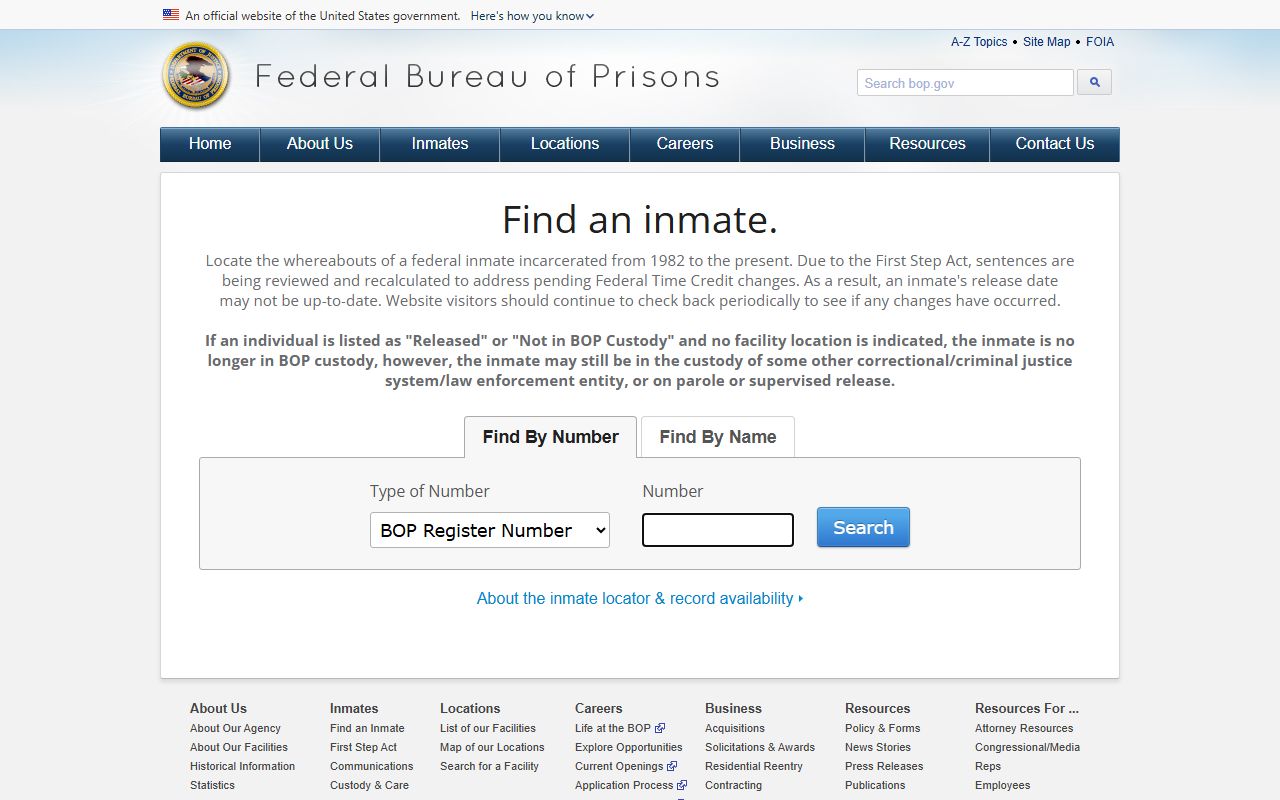
The form splits into a number path and a name path. The table below lists the BOP locator search fields and the columns a result returns.
| Field Label | Type | Required | Notes / Format |
|---|---|---|---|
| Find By Number | Tab | Optional path | Search by an assigned ID number. |
| Type of Number | Dropdown | Yes for number search | BOP Register Number, DCDC Number, FBI Number, or INS Number. |
| Number | Text | Yes for number search | BOP register format is #####-###. |
| Find By Name | Tab | Optional path | Search by name instead of number. |
| First | Text | Yes for name search | First name is required on the name path. |
| Middle | Text | No | Narrows results when a name is common. |
| Last | Text | Yes for name search | Last name is required on the name path. |
| Race | Dropdown | No | Demographic filter. |
| Age | Text / number | No | Demographic filter. |
| Sex | Dropdown | No | Demographic filter. |
| Search | Button | n/a | Submits the locator query. |
| Clear Form | Button | n/a | Resets all fields. |
A BOP result lists Name, Register #, Age, Race, Sex, Release Date, and Location. The release date field is the one most people care about, but read it next to the location field, since a recalculated date can change. For paroled offenders, the New Jersey State Parole Board offender search is the right resource. The board's Public Information Office answers custody and parole questions at SPB-Public-Info-Office@spb.nj.gov.
Note: A "released" result in any single system only rules out that one form of custody, so confirm across the county, state, and federal tools before you treat a person as fully released.
Verifying a Monmouth County Release in Person or by Phone
Online tools answer most questions, but not all of them. Data can lag, a name can be misspelled, and a sealed matter may hide a record. When the search results do not match what you expect, go straight to the source. For county custody, that source is the Monmouth County Correctional Institution. Call MCCI at 732-431-7860 and ask the records staff to confirm whether a person is in custody or has been released.
Bring details. A full legal name plus a date of birth cuts through the confusion that common names create. If you have a case number or a booking date, share that too. Staff work within rules on what they can disclose, so be ready for limits on certain details. Medical, mental health, juvenile, and security information stay private and will not be confirmed over the phone.
Monmouth County Correctional Institution
1 Waterworks Road
Freehold, NJ 07728
732-431-7860
For state custody questions, the State Parole Board's Public Information Office is the contact, and for federal questions the BOP locator result page points to the facility holding the person. Match the question to the office that owns the record, and you save yourself a long chain of transfers.
The New Jersey Sex Offender Registry
Some released individuals carry a registration duty under Megan's Law. New Jersey's registry framework comes from N.J.S.A. 2C:7-1 et seq., the set of statutes that created community notification and the public registry. The New Jersey State Police maintain the public registry, which lets residents search for registered offenders who are subject to public disclosure. Not every registrant appears in the public file, since tier classification controls who is listed.
The registry is a public-safety tool, not a general background check. State law restricts using registry data to harass, threaten, or discriminate against a listed person, and misuse can carry legal consequences. Most registry pages ask you to acknowledge a disclaimer before you can search. The table below lists the typical search fields the registry uses.
| Field Label | Type | Required | Notes / Format |
|---|---|---|---|
| Name search | Text | Varies | Look up a registrant by first or last name. |
| Location / ZIP search | Text | Varies | Search by town or ZIP to map nearby registrants. |
| Registry acknowledgement | Checkbox / button | Yes | You must accept the use disclaimer before searching. |
Federal resources can help when a search crosses state lines. The U.S. Department of Justice keeps a public hub to locate a prison inmate or sex offender, which links the national registry and the BOP locator in one place. The image below shows that DOJ locator resource page.
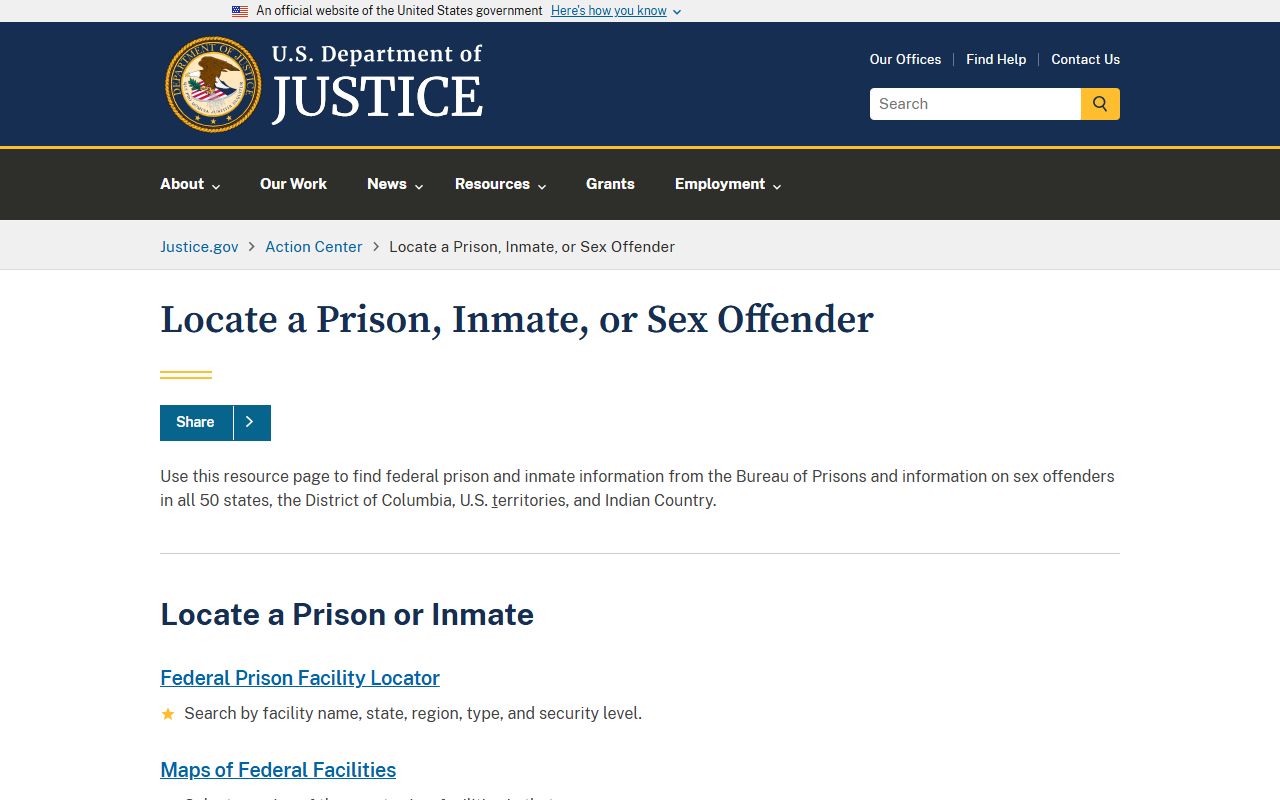
That federal hub is useful when a person may have moved or registered in another state. For someone tied to Monmouth County, though, the New Jersey State Police registry remains the primary source, and a call to local police can clear up any address question.
Parole and Probation Information
Release does not always mean a clean break from supervision. Many people leave custody onto parole, which is community supervision after a prison term, or probation, which a court orders in place of or after jail time. In New Jersey, parole runs through the State Parole Board, while probation is supervised through the courts. The two are different, though people often blur them.
The State Parole Board provides offender and parole information and follows an OPRA process for records requests. Its offender search links the NJDOC locator and lists the contact for parole questions. If a released person is under parole supervision, conditions usually cover where they can live, who they can contact, drug testing, and check-ins with a parole officer. A violation can send a person back to custody, which is why the VINE alert system matters to victims.
New Jersey State Parole Board
Public Information Office
SPB-Public-Info-Office@spb.nj.gov
Probation tied to a Monmouth County case is handled through the Superior Court's probation operations. To confirm whether a person is on probation or to report a concern, the court that imposed the sentence is the place to start. Court case status, in turn, shows up through the judiciary, which the Monmouth County court records page explains in detail.
Reentry Resources in Monmouth County
Coming home after custody is hard, and the first weeks set the tone. Stable housing, a job, and treatment access all lower the odds of going back. Monmouth County links several human-services resources from its official channels, and the county prosecutor runs victim-side support that overlaps with release notification. The list below points to the main official routes.
- Monmouth County Prosecutor Victim-Witness Unit, which assists victims with VINE registration and release notification.
- Monmouth ACTS, the county's human-services information hub linked from the county homepage.
- County behavioral health resources, also linked from the county homepage, for mental health and substance-use support.
- New Jersey Office of the Public Defender, for indigent defense and post-release legal questions tied to a criminal case.
For legal needs after release, the courts run self-help tools that a returning resident can use without a lawyer. Expungement, fee waivers, and record requests all start there. Civil legal aid for housing or benefits problems is also available statewide. The reentry path leans on a mix of county human services and state legal resources, so it helps to know that no single office handles all of it.
Civil Rights Restoration After Release
Release restores some rights right away and leaves others to a longer process. Voting is the clearest example. New Jersey restores voting rights once a person is released from incarceration, so a returning resident can register and vote even while on parole or probation. Anyone unsure of their status should confirm current rules with the New Jersey Division of Elections, since registration deadlines and procedures change.
A criminal record can still block jobs, housing, and licensing long after release. Expungement is the legal tool that clears qualifying records from public view. New Jersey runs an online expungement process through the courts under the judiciary's Self Help resources, and the State Police update their records once an order is granted. The process has waiting periods and eligibility rules that depend on the offense, so reading the court's guidance first saves time.
Driving is often the missing piece for getting back to work. A license suspended during a case may need to be restored before a person can drive legally. The New Jersey Motor Vehicle Commission explains restoration steps, fees, and requirements on its license suspension and restoration page. Clearing a record, restoring a license, and confirming voter status together cover most of the civil-rights questions that come up after release.
Note: Voting rights in New Jersey return on release from incarceration, but a person should verify current registration rules with the state Division of Elections before counting on it.