
OPRA and Monmouth County Public Records
New Jersey government records open to the public under the Open Public Records Act, known as OPRA. The law sits at N.J.S.A. 47:1A-1 et seq. and took effect July 7, 2002, replacing the old Right to Know Law. OPRA covers county, town, school, and other public-agency records across the state. That means Monmouth County offices, from the County Clerk to the Sheriff, fall under it. The act sets a public policy that favors access while still protecting privacy and certain exempt material.
Almost anyone can file an OPRA request. You do not have to be a state resident, and you do not have to say why you want the record. A "government record" is broadly defined to include papers, forms, maps, photos, and electronic files an agency makes or keeps in its work. Some categories are carved out by law, which is why not every document is handed over. The state's Government Records Council, or GRC, publishes a plain-language Citizen's Guide to OPRA that walks through your rights. The GRC updated that guide in 2024 to reflect P.L. 2024 c.16, a set of amendments that changed parts of how requests and fees work.
The screenshot below comes from the county's own OPRA information page, the starting point for most county-level requests.
You can read the county's instructions before you file at the Monmouth County OPRA information page.
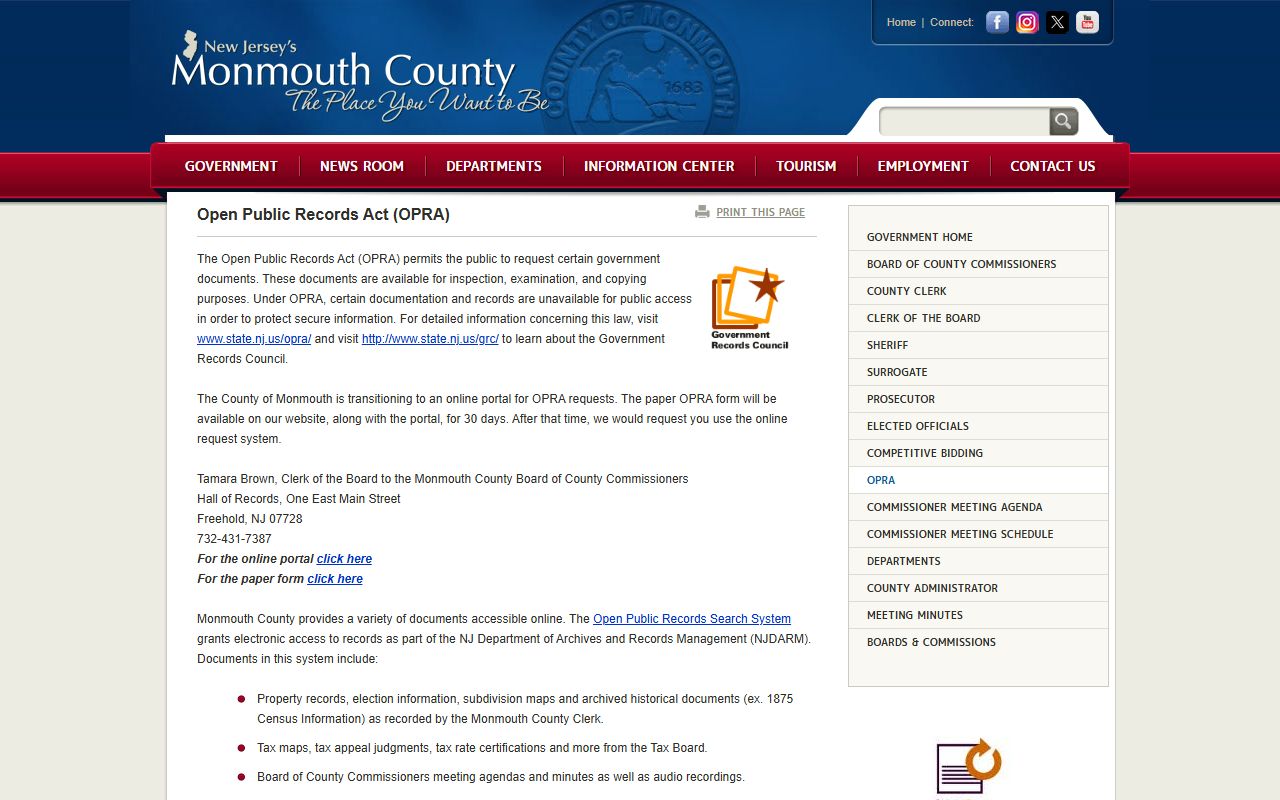
That page tells you where to send a request, which form to use, and how the county counts its response time. It is the official county source, so trust it over any third-party site.
Court Records Are Different in New Jersey
This is the part most requesters miss. County government records run through OPRA, but court records do not. The judiciary is not treated as a public agency under the act. The GRC has stated that the Supreme Court, Superior Court, Municipal Courts, the Administrative Office of the Courts, and related judicial offices sit outside OPRA. So an OPRA request for a Monmouth County court file goes to the wrong place.
Court records follow court rules instead. The main one is Rule 1:38, which makes court records open to the public unless a rule or order keeps them shut. To get a copy of a Superior Court file, you use a judiciary records request, not an OPRA letter. The two systems live in different offices and use different forms. For the full walkthrough on judiciary case files, see the Monmouth County court records page.
So before you file anything, ask one question. Is the record a county government record, like a deed or a business filing, or is it a court file, like a docket or a judgment? County records use OPRA. Court files use Rule 1:38. Mixing them up is the top reason requests get bounced.
The Monmouth County OPRS Search System
The County Clerk runs an online tool called the Open Public Records Search System, or OPRS. It is the fastest way to view many county records without filing a formal letter. The system lives at the county's OPRS search page, and it groups records by office and record set. The County Clerk's groups carry the records people ask for most often.
- Property Records, including recorded deeds and related documents
- Trade Names, used to register a business name
- Past Election Results
- Subdivision Maps
- Vote By Mail List
- Election Pulse Reports
- Early Voting Lists
OPRS works best on a desktop or laptop. The OPRS FAQ notes that full features run on Windows with Internet Explorer 11, Chrome, or Firefox, and on a Mac with Safari, Chrome, or Firefox. Tablets and phones may not support the download-as-PDF or print-document tools. If a search page seems stuck, switch to a desktop browser. For technical trouble, the county lists oprssupport@co.monmouth.nj.us as the support contact.
OPRS is for county records, not Superior Court dockets. Do not treat it as a court case search. It shines for recorded documents, business filings, election material, and county board records. When a record is not posted online, the formal OPRA request form is the next step.
County OPRA Request Form
When a county record is not in OPRS, you submit a formal OPRA request to the right county office. Monmouth County provides instructions and the official form on its OPRA page. You can find both at the county OPRA information page, which also explains where to send the request and how the county tracks it.
A good request names the records as clearly as you can. Vague requests slow things down. If you know a date range, a document type, or a department, include it. The county can ask you to narrow a request that is too broad, and it may charge fees for copies or for service that goes beyond the routine.
Keep a copy of what you send. If the county asks a question or needs payment, you want a record of the original request and its date. That date matters, because the response clock starts when the office gets your request.
Sheriff OPRA Requests in Monmouth County
The Monmouth County Sheriff's Office handles its own OPRA requests, and its rules are a little different from the County Clerk's. The Sheriff accepts OPRA requests by email only, at opra@mcsonj.org. After you send a request, you should get a confirmation reply. Do not assume the custodian received it until that reply lands in your inbox.
The Sheriff's page also lists mail, fax, and in-person options for the form itself, but the email channel is the one the office points to for submission. The image below shows the Sheriff's OPRA request instructions.
The Sheriff posts its full request instructions on the Sheriff OPRA requests page.
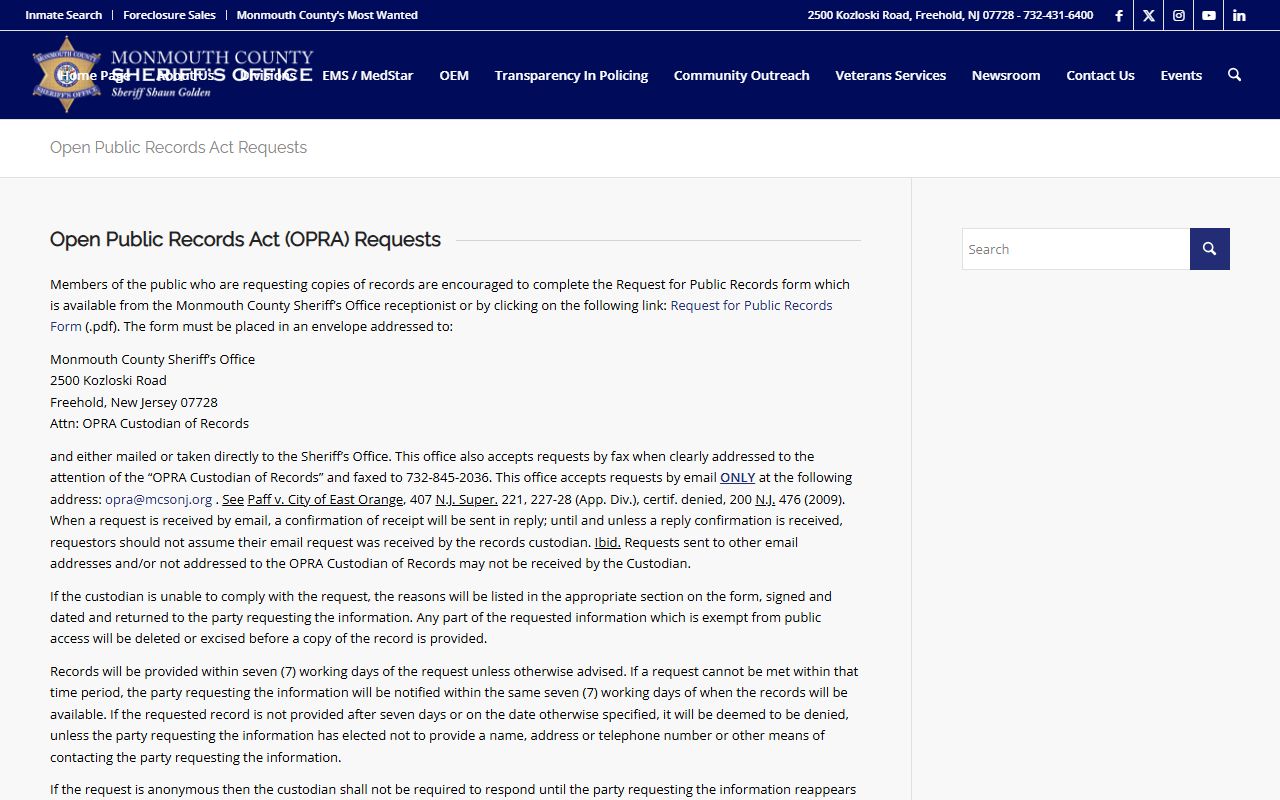
That page explains the timing too. The office states it will provide records within seven working days unless it tells you otherwise. If a request cannot be met in that window, the office notifies you within the same seven working days and says when the records will be ready.
Note: Send Sheriff OPRA requests to opra@mcsonj.org and wait for the confirmation reply before you assume the office has your request.
County Clerk SSN Redaction Form
New Jersey law lets you ask the County Clerk to redact a Social Security number, and certain other details, from recorded documents. This grew out of a 2005 addendum to the open-records law, C.47:1A-1 et seq. The County Clerk uses a Social Security Number Redaction Request Form for this. You fill in your details, identify each document, and submit it to the Clerk with a copy of the recorded document. The fields on the form are listed below.
| Field | Required | Notes |
|---|---|---|
| Name of Requester | Yes | Identifies who is asking. |
| Address | Yes | Mailing address for the reply. |
| Phone | Yes | Contact number. |
| Signature and Date | Yes | Signed and dated by the requester. |
| Instrument Number | Conditional | For each document needing redaction. |
| Book and Page | Conditional | Recording reference if known. |
| Document Type | Conditional | Type of recorded document. |
| Recording Date | Conditional | Date the document was recorded. |
The fee is $10.00 per request, by check payable to "Monmouth County Clerk." Average compliance time is seven working days. The custodian keeps the right to charge a special service fee for an unusual request, and may ask for prepayment or a deposit. Send the completed form and a copy of the document to the Monmouth County Clerk, 33 Mechanic Street, Freehold, NJ 07728.
How to File a Public Records Request in Monmouth County
Filing is not hard once you know the office and the law. Most county records use OPRA. Court files do not. The steps below cover a routine county OPRA request, from start to finish.
- Check OPRS first. Many county records, like deeds and trade names, are already posted at the county search system, so you may not need a formal request at all.
- Pick the right office. The County Clerk handles recorded documents and election records, while the Sheriff handles its own records by email. Court files go through the judiciary, not OPRA.
- Describe the records clearly. Name the document type, a date range, and any case or instrument number you have, so the custodian can find it fast.
- Submit the request. Use the county OPRA form for county records, or email opra@mcsonj.org for Sheriff records. State guidance on filing also sits at OPRA Central.
- Wait for the response and pay any fees. The office will tell you the cost, then release the records once payment clears.
If you are unsure whether a record is a county record or a court record, ask the office before you file. A quick call can save a week of waiting on a request sent to the wrong custodian.
Fees and Special Service Charges
Most public-record fees in Monmouth County are small. The County Clerk redaction request runs $10.00 per request. Older redaction-form copies were listed at $0.25 per page in archived county material. OPRA also allows agencies to charge statutory copy fees, and a special service charge when a request takes extraordinary time or effort. The table below shows the county fees found in official sources.
| Item | Amount |
|---|---|
| County Clerk SSN redaction request | $10.00 per request |
| Older redaction-form copies | $0.25 per page |
| Standard OPRA copy fees | Statutory rate set by law |
| Special service charge | Set by custodian for extraordinary requests |
A special service charge is not a penalty. It covers the real cost when a request needs heavy staff time, large data pulls, or custom work. The custodian can ask for prepayment or a deposit before that work begins. If a fee seems high, ask the office to explain how it was figured, since OPRA expects charges to track actual cost.
Note: court copy fees are separate and run through the judiciary, not OPRA, so a county fee schedule will not match what the courts charge.
Records That Are Exempt or Restricted
Not every record is public. OPRA and other laws shield certain material. Many personnel and pension records are limited under N.J.S.A. 47:1A-10, though some basic public-employment facts still come out. Records can also be withheld for privacy, safety, security, or active investigations.
On the criminal side, sealed and expunged records, juvenile records, and confidential criminal-justice material stay closed. Personal identifiers like Social Security and account numbers are redacted. For records tied to arrests and charges, the Monmouth County criminal records page explains what is open and what is not. Family-court material, like domestic violence and adoption files, is also heavily restricted.
If a record falls under an exemption, the custodian must tell you which one applies. You do not just get silence. That written reason matters if you decide to challenge the denial.
Appeals and the Government Records Council
A denial is not the end of the road for a county OPRA request. If a Monmouth County office denies access, or fails to respond, you have two routes. You can file a complaint with the Government Records Council, or you can bring a proceeding in Superior Court. This appeal right comes from N.J.S.A. 47:1A-6.
The GRC is the state body that hears OPRA disputes for covered agencies. It is built to be a lower-cost option than court, and you can file a complaint without a lawyer. The Superior Court route may move faster in some cases and can award attorney fees when a requester prevails. Either way, the deadlines are short, so do not sit on a denial.
Before you file anything, it helps to read the council's own plain-language overview. The GRC Citizen's Guide to OPRA lays out your rights, the deadlines, and how a complaint moves, as shown below.
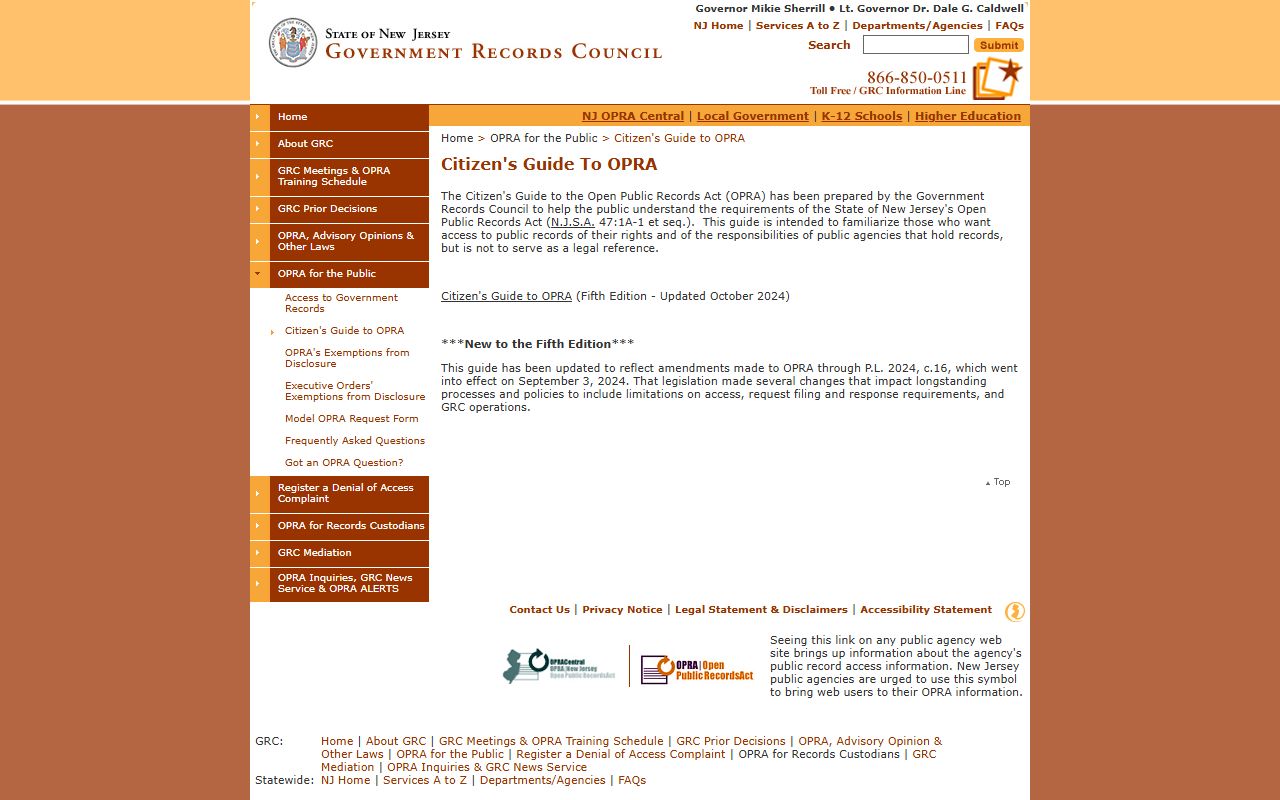
That guide is the best starting point when a Monmouth County office denies a request or misses a deadline.
This appeal path covers county records only. A court-record denial follows judiciary procedures, not the GRC, because the courts sit outside OPRA. For marriage and divorce files, which mix county and court handling, see the Monmouth County marriage and divorce records page. Common questions also get answered on the FAQ page.