
Arrest Records in Monmouth County
An arrest record is the paper trail of a person being taken into custody. In Monmouth County, that record begins when the Sheriff or a local police force makes an arrest and brings the person in for booking. Booking is the intake step. Staff log the name, the date and time, the charges, and a booking photo, and they run a classification check. Most arrested people in the county pass through the Monmouth County Correctional Institution, or MCCI, which the Sheriff runs as the central reception and processing center for both sentenced and unsentenced inmates.
An arrest record is not the same as a criminal court record, and neither one proves guilt. The arrest record shows that police charged someone. The court record shows what the court later did with those charges. A conviction record is narrower still, since it reflects only cases that ended in a finding or admission of guilt. This page leads with the arrest side. For the full case file that follows an arrest, the Monmouth County court records page is the better starting point.
Both kinds of record are public in most cases. Some are not. Juvenile arrests, sealed cases, and expunged matters are closed by law and will not show in a normal search.
How to Search Monmouth County Arrest Records
The fastest way to find a recent Monmouth County arrest is the Sheriff's online inmate search. It lists people currently held at MCCI and the charges that brought them in. The tool is run by the Monmouth County Sheriff's Office under Sheriff Shaun Golden and updates on a regular basis. You can search by first name, last name, or the charging agency. Leaving the name fields broad and narrowing by agency can help when you are not sure of the spelling.
- Open the Sheriff inmate search page.
- Enter a First Name, a Last Name, or both. A last name alone often works best.
- Pick a Charge Agency from the dropdown, or leave it on the default of all agencies.
- Click Search, then open an inmate row to view the charges grouped below the name.
The roster only covers people held right now at the county jail. Someone arrested and released the same day, sent to a state prison, or booked into federal custody will not appear there. For state custody, the New Jersey Department of Corrections has its own offender search. For people held at MCCI, the Monmouth County inmate records page goes deeper into the roster, the facility, and visitation. If the person already has a court case open, the arrest detail will also tie back to a docket number on the judiciary side.
Note: The Sheriff warns that misuse of inmate-search data to threaten, harass, or intimidate can lead to criminal prosecution or civil liability.
Arrest Records vs. Criminal Court Records
People mix these two up all the time. An arrest record is made at booking by the police or Sheriff. A criminal court record is made later, once a charge is filed and the case moves into the Superior Court Criminal Division or a Municipal Court. The arrest is the front end. The court file is everything that happens after. One name can have an arrest with no court case, or a court case that started without a fresh arrest, such as a summons.
| Arrest Record | Criminal Court Record | |
|---|---|---|
| Source | Sheriff or local police | Superior Court or Municipal Court |
| Created When | Booking at MCCI | When charges are filed |
| Contents | Booking info, charges, mugshot, holding status | Complaints, indictments, pleas, motions, disposition |
| Where to Search | Sheriff inmate search | NJ Courts case search |
So which do you need? If you want to know whether someone is in jail right now and on what charges, the arrest and booking side answers that. If you want the outcome, the next hearing, or the final disposition, you want the court file. Full case history sits on the court records page, which walks through the state judiciary portal.
Charges vs. Convictions
A charge is an accusation. A conviction is a result. That gap matters, because an arrest record can list serious charges that were later dropped, downgraded, or never proven. Under our system, charges only need probable cause to be filed. A conviction needs proof beyond a reasonable doubt, or a guilty plea. Reading a charge as if it were a conviction is the most common mistake people make with arrest data.
| Charge | Conviction | |
|---|---|---|
| Stage | Accusation at or after arrest | Verdict or guilty plea |
| Burden of Proof | Probable cause | Beyond a reasonable doubt |
| Who Decides | Police, prosecutor, grand jury | Judge or jury |
| Public Record | Yes, unless sealed | Yes, unless expunged |
In Monmouth County, the formal charge can take a few forms. A complaint is the basic charging paper. An indictment is a charging document returned by a grand jury for an indictable, or felony-level, offense. An accusation is used when a defendant waives the grand jury. The disposition field on the later court record is what tells you how the charge ended. Dismissed, downgraded, or not guilty all mean there was no conviction.
The Prosecutor's Role in Monmouth County
Once police make an arrest, the case heads toward the Monmouth County Prosecutor's Office for any serious crime. In New Jersey, the county prosecutor is the local version of a district attorney and handles indictable, felony-level matters. The current prosecutor is Raymond S. Santiago, confirmed for a five-year term. His office decides what charges to bring, presents cases to the grand jury, and runs the prosecution in the Superior Court Criminal Division.
The office is large. It oversees roughly 275 staff, including close to 60 assistant prosecutors and about 80 detectives, and coordinates with nearly four dozen municipal police departments serving around 645,000 residents. That scale shapes how arrests turn into cases, since the office screens charges and routes them to trial, plea, diversion, or dismissal. Less serious matters, like most traffic and disorderly persons offenses, stay in Municipal Court instead of going to the prosecutor for indictment.
Monmouth County Prosecutor's Office
132 Jerseyville Avenue
Freehold, NJ 07728
732-431-7160
prosecutor@mcponj.org
A grand jury reviews the State's evidence and returns an indictment when it finds enough cause. That step is what moves a charge from a complaint into an indictable case. The arrest record reflects the front of that pipeline. The indictment, plea, and sentence show up later in the court file.
Diversion and Recovery Court
Not every arrest ends in a conviction or a jail term. Monmouth County runs several programs that route eligible people away from the standard criminal path. The Prosecutor's Office leads a diversion program called ReStart. It is a prosecutor-led program, not a separate court, so it does not produce its own court records the way a judge-run program would. Diversion can mean charges are held back or dismissed if a person completes the program's conditions.
The county also takes part in New Jersey's Recovery Court framework, sometimes still called drug court. Recovery Court is a court-supervised treatment model for people with substance-use disorders. Participants get assessment, treatment, regular court check-ins, and a mix of incentives and sanctions instead of a purely custodial sentence. Eligibility depends on the offense and the person's history. A related initiative, Link 2 Care, supports people with substance-use or behavioral health needs as their cases move through the system. Because these programs change the outcome of a charge, they affect what a later criminal court record shows.
Sealed vs. Expunged Records
Sealing and expungement both restrict access to a criminal record, but they are not the same thing. Sealing hides a record from public view while it still exists in some form. Expungement goes further. Under New Jersey law, an expungement isolates and removes eligible arrest, charge, and conviction records so that, for most purposes, the matter is treated as if it never happened. Expungement runs through the courts under N.J.S.A. 2C:52-1 et seq.
| Sealed | Expunged | |
|---|---|---|
| Visibility | Hidden from public search | Isolated and treated as never existing |
| Law Enforcement | Limited access remains | Very limited, only as the statute allows |
| How It Happens | Court order or rule | Court-ordered under N.J.S.A. 2C:52-1 et seq. |
| Eligibility | Set by court rule | Offense type, waiting periods, and prior history |
People file for expungement through the NJ Courts online application under the Self Help section. The State Police Expungement Unit then processes the final orders and disseminates them to criminal justice agencies when the statute allows. The unit reviews petitions, checks for conflicts, and runs a public portal that lets a petitioner track a pending case. After an expungement, public systems should treat the arrest and charge as no longer available, though criminal justice agencies keep limited access in defined situations.
NJSP Expungement Unit
P.O. Box 7068
West Trenton, NJ 08628-0068
609-671-7900
expungementunit@njsp.gov
Mugshots and Booking Photos
A mugshot, or booking photo, is taken during intake at the jail. It is part of the arrest record and ties a face to the booking entry. The Sheriff's inmate search can display custody data for people held at MCCI, and booking detail is generated as part of classification and processing. Photos and booking data for current inmates trace back to the same Corrections Division that runs the facility.
Public access to booking photos is not unlimited. Juvenile bookings are closed. Records tied to sealed or expunged cases should not appear. And misuse of any inmate or booking data to harass a person can carry legal consequences, as the Sheriff's own notice warns. Avoid third-party mugshot sites. They often hold stale data and charge removal fees, and they are not official sources. The Sheriff's tool is the record of authority for current county bookings.
What Is Public and What Is Restricted
New Jersey splits records by who holds them. County government records fall under the Open Public Records Act, OPRA, at N.J.S.A. 47:1A-1 et seq. Court records do not. The Government Records Council has stated the judiciary is not a public agency under OPRA, so Superior Court files follow court rules instead. Arrest and booking data held by the Sheriff and police is law-enforcement record material, with its own access limits and exemptions. The GRC keeps a plain-language guide to how OPRA works, which helps when you are figuring out which request route to use.
The GRC frequently asked questions page, shown below, is a good starting point for the public-access rules behind a records request.
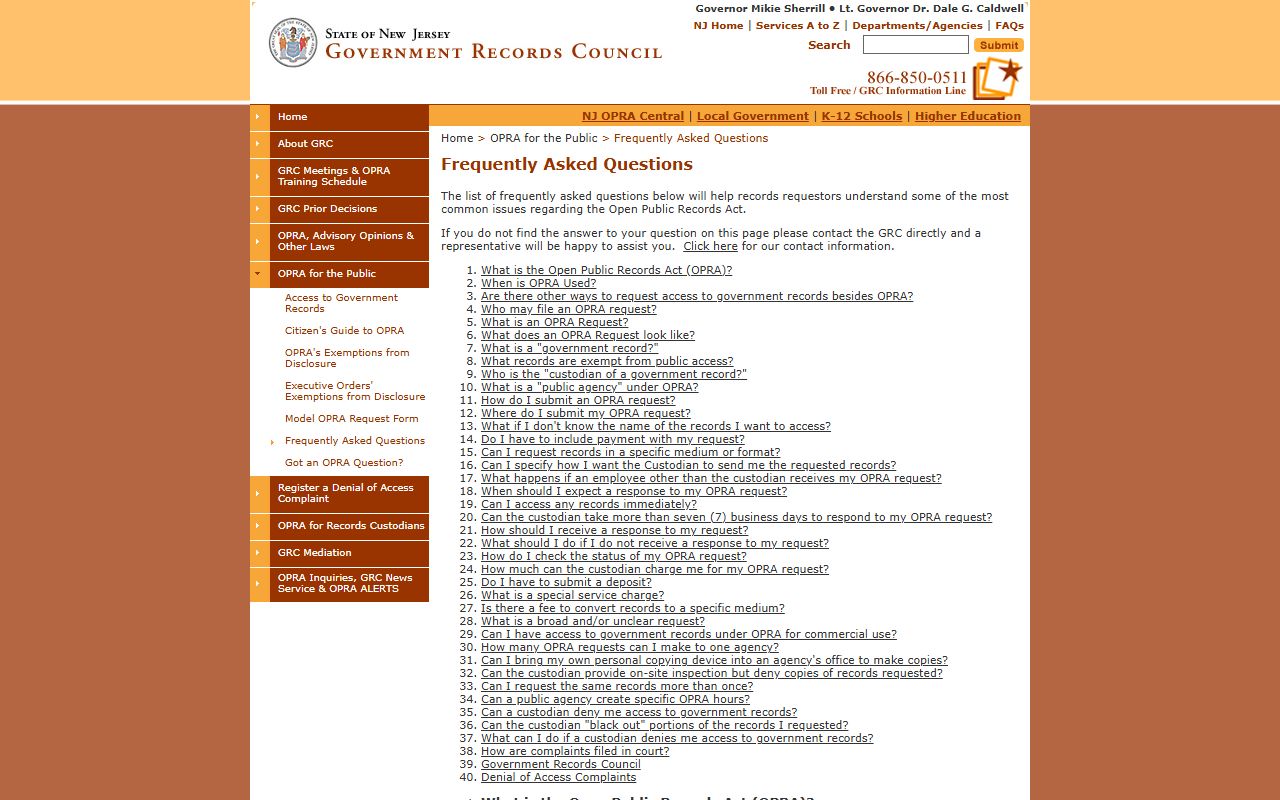
The page lays out who OPRA covers, how to file a request, and what an agency can and cannot withhold. That framework matters because an arrest record request to a police department or the county runs through OPRA, while a court-file request runs through the judiciary instead.
Several categories stay closed no matter how you ask. These include juvenile delinquency files, expunged and sealed cases, domestic violence and restraining order matters, child welfare records, mental health and civil commitment files, grand jury material, and presentence reports. Personal identifiers like Social Security numbers, financial account numbers, birth dates, and the names of minors are redacted before any record goes public. Active investigations may also be withheld to protect the case.
Victim and Witness Help
An arrest record often marks the start of a long process for the people harmed by a crime. The Monmouth County Prosecutor's Office runs a Victim-Witness Unit to help them through it. The unit explains how the criminal and juvenile justice systems work, shares case status and disposition information, and offers crisis intervention. Staff can arrange transportation when a victim or witness is subpoenaed and provide secure waiting areas at court.
The unit's services go further than the courtroom. It helps with the return of property, victim impact statements, accompaniment to grand jury and court proceedings, Victims of Crime Compensation Office applications, restitution requests, and letters to employers, schools, or creditors. It also registers people for VINE, the Victim Information and Everyday Network, which sends automatic alerts about custody status and release. VINE registration is one of the most practical tools for anyone worried about when a held person might get out.
Public Defender and Defense
On the other side of an arrest, a defendant who cannot afford a lawyer has a right to one. The New Jersey Office of the Public Defender handles indigent criminal defense statewide. Monmouth County is served by the Monmouth Trial Region office in Freehold. Eligibility turns on indigency, and the court works with the public defender to confirm it. A public Monmouth case filing, for example, listed an assistant deputy public defender from this same regional office representing a defendant.
Office of the Public Defender
Monmouth Trial Region
7 Broad Street
Freehold, NJ 07728
732-308-4320
If you have an open warrant or a pending charge, defense counsel is the safest contact before you act. A lawyer can confirm the status, arrange a surrender if needed, and protect your rights. For warrant questions specifically, the Monmouth County warrant records page explains the types of warrants and how to resolve one.
Background Check Considerations
People search arrest records for many reasons, but not every reason is allowed. A formal background check used for hiring, housing, credit, or insurance falls under the federal Fair Credit Reporting Act, the FCRA. Those checks must come from a regulated consumer reporting agency and follow strict rules, including notice and consent. A casual online lookup is a different thing. It can satisfy curiosity, but it cannot stand in for an FCRA-compliant report.
Important: This site is not a consumer reporting agency under the FCRA, and its information may not be used for employment, tenant, credit, or insurance screening.
Restricted Criminal Records in Monmouth County
Some arrest and criminal records are off limits to the public even when the underlying event was real. Juvenile delinquency records are protected by statute and court rule, with access limited to the court, prosecutor, law enforcement, the victim, and other authorized parties. Sealed records do not show in a public case search. Expunged records are treated as no longer available in ordinary public systems.
Other closed categories include adoption files, domestic violence and restraining order matters, child protective records, mental health and commitment records, grand jury material, and presentence reports. Active investigations may also be withheld while a case is open. Jail medical and mental health details, security flags, and victim identifiers should not be expected in a public inmate search either. When a record is unclear or seems to be missing, the right move is to confirm the current status with the office that holds it rather than rely on a partial online result.