
How to Search Monmouth County Court Records
Court cases in Monmouth County are state records, not county-clerk records. The starting point is the New Jersey Judiciary, not a local district clerk. The state runs a public "Find a Case" page and a civil and criminal case search portal that covers Superior Court matters across every vicinage, Monmouth included. Municipal traffic and local cases use separate judiciary tools.
Before you start, gather what you have. A party name or a docket number gets you the furthest. The portal uses anti-bot checks, so you may face a captcha and need a normal browser with cookies turned on.
The New Jersey Courts Find a Case page lists the search tools and which records each one covers. The screenshot below shows that landing page.
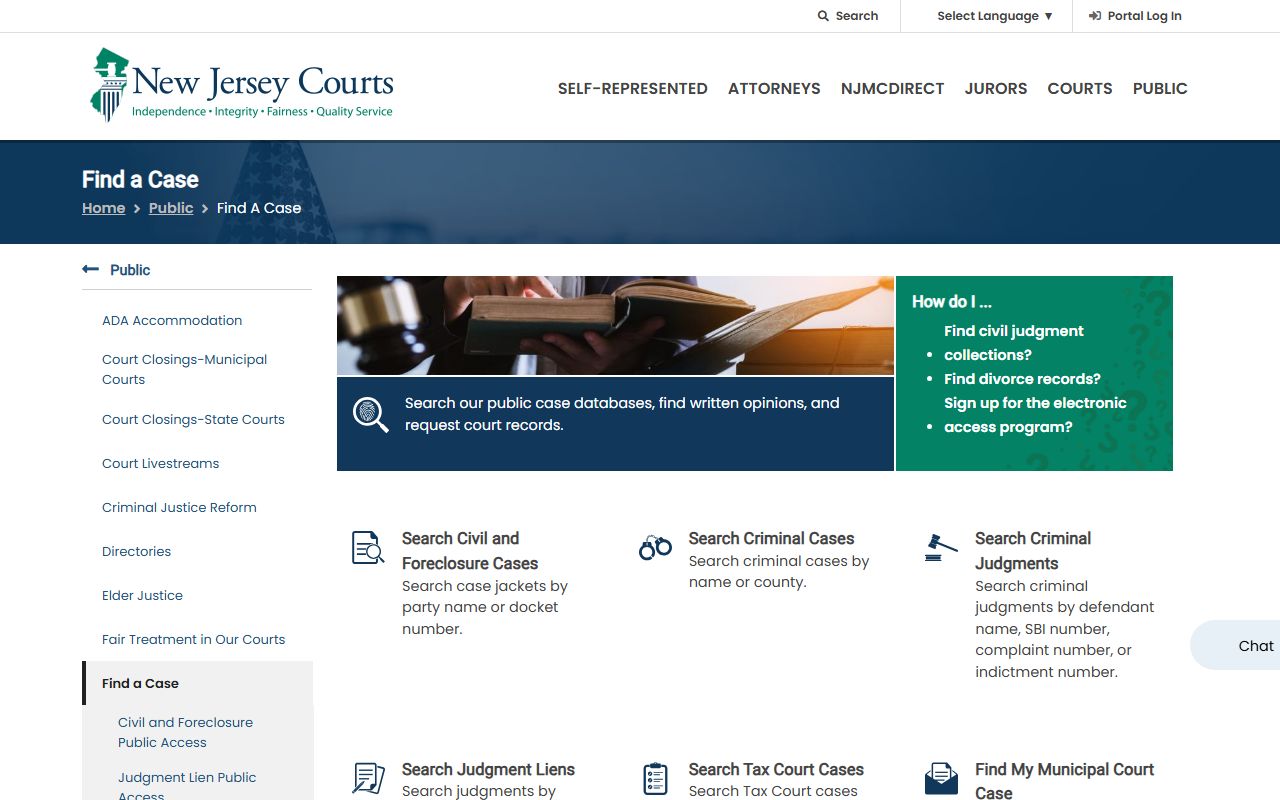
From there, the steps are simple. Most people find a case in a few minutes once they pick the right tool.
- Open the civil and criminal case search portal or start from the Find a Case page.
- Pick your search type under "Search By," then enter a party name or a case or docket number.
- Complete the captcha so the system knows you are not a bot.
- Click Search and review the results for case number, parties, filing date, vicinage, and status.
- If a document is not online, file a Judiciary Records Request Form CN 10200 to ask for a copy.
The county's Open Public Records Search System, called OPRS, is a separate tool. It covers county records like property records, trade names, and election materials. Do not use OPRS as the main Superior Court docket search. More on that split appears on the Monmouth County court records page.
The Monmouth County Judicial System
New Jersey uses one statewide judiciary instead of county-built trial courts. The main trial court is the Superior Court of New Jersey, and Monmouth County's court operations form the Monmouth Vicinage. The official vicinage page names Assignment Judge Marc C. Lemieux and Trial Court Administrator Gurpreet Singh. The court runs from the Monmouth County Courthouse in Freehold.
Above the trial level sits the Appellate Division, which hears appeals, and then the Supreme Court of New Jersey. Below it, Municipal Courts handle traffic, local ordinance, and many low-level criminal matters. Each level has a clear job.
Case flow: Municipal Court › Superior Court › Appellate Division › Supreme Court of New Jersey
| Court | Jurisdiction | Case Types |
|---|---|---|
| Municipal Court | Local, within each town | Traffic, ordinance, disorderly persons, many DUI/DWI |
| Superior Court (Monmouth Vicinage) | Countywide trial court | Criminal, civil, family, chancery, probate disputes |
| Appellate Division | Statewide appeals | Appeals from trial courts, Tax Court, agencies |
| Supreme Court of New Jersey | Highest state court | Final appeals, court rules, judicial administration |
The Tax Court is a separate statewide court for state tax disputes and local property-tax appeals. Federal cases are different again and go through the federal courts that serve Monmouth County. Full detail on each level sits on the Monmouth County Superior Court page.
Monmouth County Courthouse in Freehold
The county's court functions are centered in Freehold, the county seat. The main building handles Superior Court matters for the Monmouth Vicinage, including criminal, civil, family, and chancery work. The official vicinage page also links jury service, chambers contacts, ADA accommodations, and interpreter services.
The courthouse address shows up two ways in official sources, as 71 Monument Street and as 71 Monument Park. Both point to the same downtown Freehold court complex. The official Monmouth Vicinage page is the best source for current hours and contacts; the screenshot below shows that page.
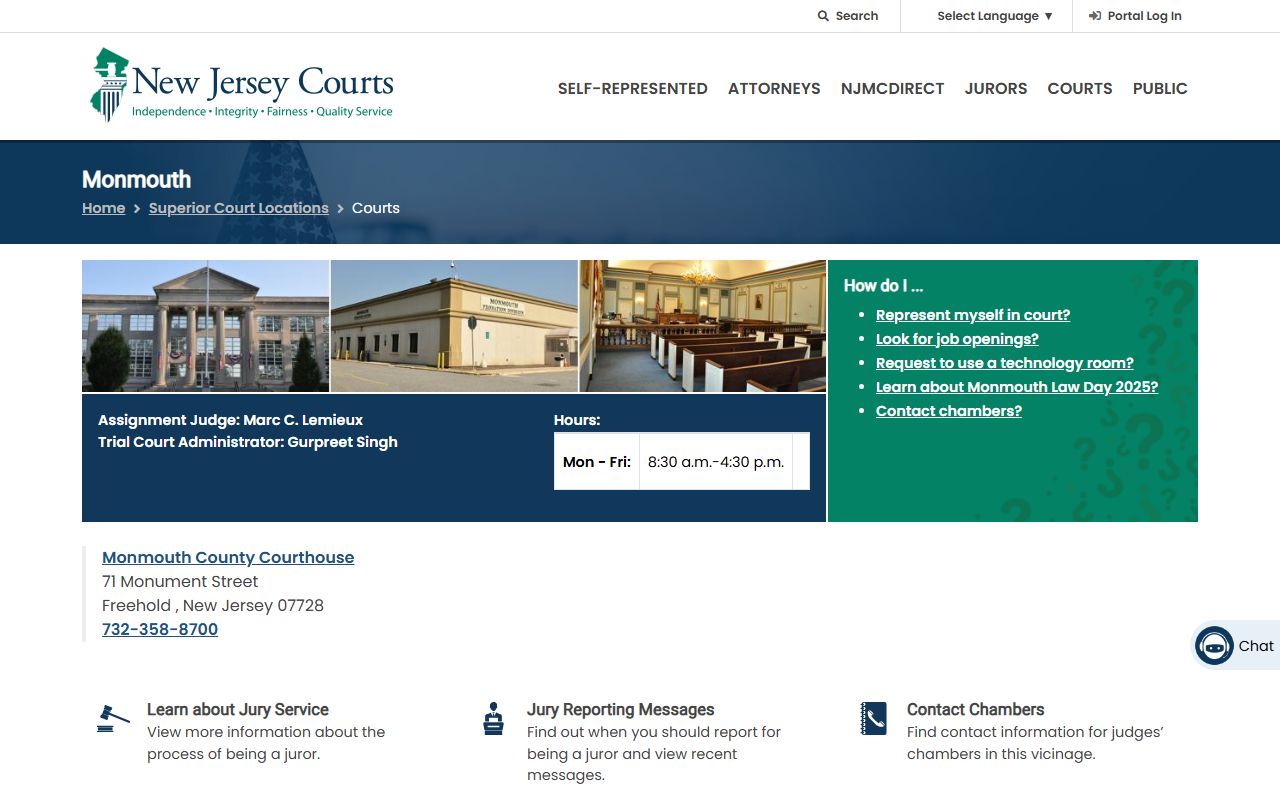
Public hours are Monday through Friday, 8:30 a.m. to 4:30 p.m. Call ahead before a visit to confirm current security rules.
Types of Court Records Available in Monmouth County
Monmouth County court records cover several case types, and different divisions of the Superior Court produce each one. The Civil Part handles money disputes, foreclosure, and general equity. The Criminal Division handles indictable cases. The Family Division handles divorce, custody, and juvenile matters. The Chancery Division, Probate Part handles contested estates.
Each record type carries its own access rules. Some are open under court rule; others are sealed or redacted to protect privacy.
- Criminal records - complaints, indictments, pleas, orders, and sentencing for indictable cases.
- Civil records - complaints, answers, motions, judgments, and liens.
- Family and divorce records - dissolution, custody, support, with many parts kept confidential.
- Probate records - wills, estate administration, and guardianship through the Surrogate.
- Traffic records - tickets and local matters handled by Municipal Courts.
County records sit apart from court records. The county clerk keeps property records, trade names, and election materials, searchable through OPRS. The screenshot below shows the OPRS search page.
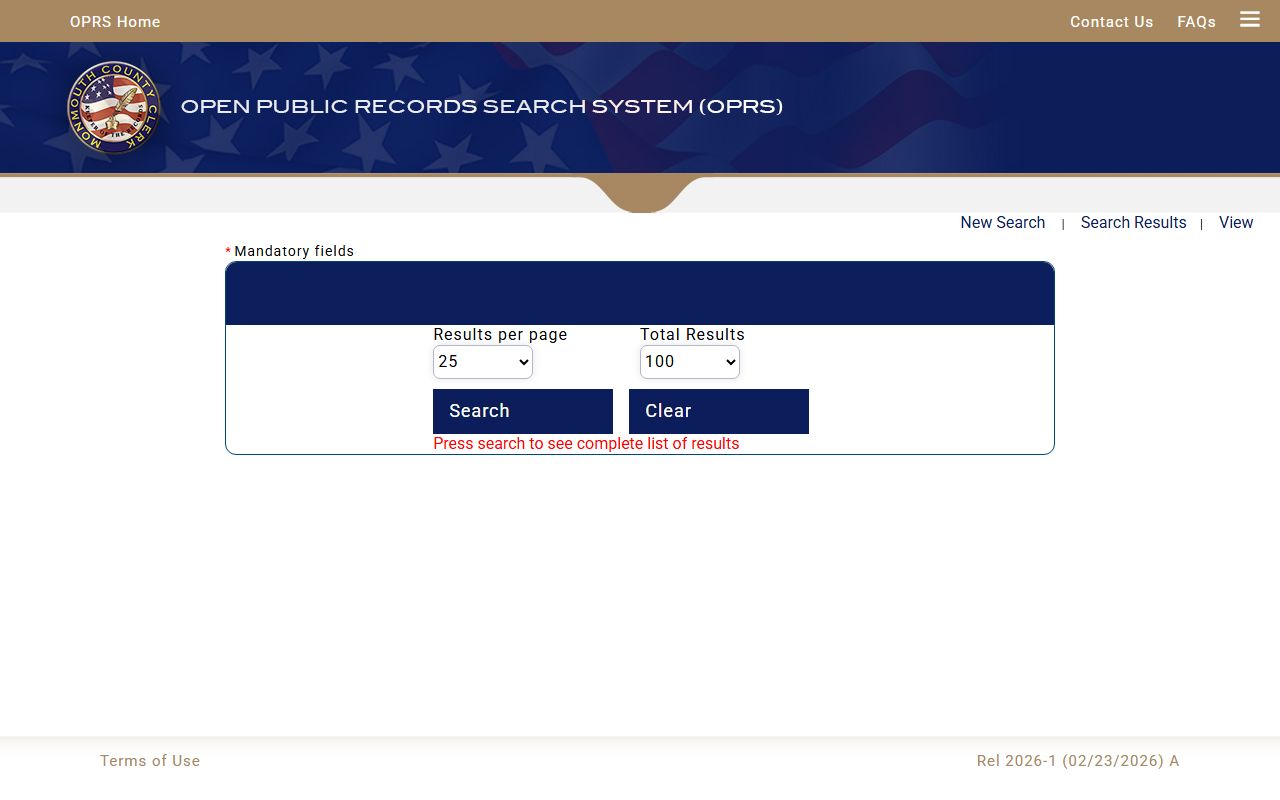
For deeper coverage of county-held records, see the Monmouth County public records page.
What Monmouth County Court Records Show
A public court record usually lists the same core fields. New Jersey case numbers tie to the division and case type. Public criminal filings in the county, for example, have shown case values like "MON-18-004915" and indictment number "19-02-0283-I." The table below breaks down the common fields.
| Field | What It Shows |
|---|---|
| Case Number | The court's tracking number tied to division and case type. |
| Filing Date | When the case or document was filed or recorded. |
| Parties | Plaintiff or State versus defendant or respondent. |
| Charges / Cause | The criminal charge or the civil claim at issue. |
| Disposition | The outcome, such as pending, dismissed, or judgment. |
| Sentence / Judgment | The penalty after conviction or the civil award. |
Records also show the judge, attorneys, hearing dates, and financial fields like fines or restitution. Sensitive data is redacted. Social Security numbers, account numbers, birth dates, minor names, and protected addresses are removed before a record is made public.
Public Access Laws for Monmouth County Court Records
Two systems control access in New Jersey, and people mix them up all the time. County government records fall under the Open Public Records Act, or OPRA. Court records do not. The Government Records Council has stated that the judicial branch is not a public agency under OPRA, so Monmouth Superior Court records follow court rules instead.
The key court rule is Rule 1:38, which makes court records open unless a rule or order makes them confidential. County records, by contrast, run through OPRA and its fee and response rules. Knowing which system applies tells you which request form to use.
Key Statutes:
N.J.S.A. 47:1A-1 - sets New Jersey's policy that government records should be open to the public, with limits.
New Jersey Court Rule 1:38 - governs public access to court records and lists what stays confidential.
N.J.S.A. 2C:52-1 - the expungement statute family used to seal eligible criminal records.
The Government Records Council Citizen's Guide walks through OPRA in plain terms and was updated in 2024. More detail sits on the public records page.
Records That Are Restricted or Confidential
Not every court file is open. Court rule and statute keep several categories private. These include juvenile delinquency records, expunged and sealed cases, adoption files, domestic violence and restraining order records, and child welfare matters. Mental health and civil commitment records are closed too, along with grand jury material and presentence reports.
To view a sealed record, you generally need a court order or proof that you are an authorized party. Expungement in New Jersey runs through the courts, and the State Police Expungement Unit processes the final orders under N.J.S.A. 2C:52-1 et seq. After expungement, most public systems should treat the matter as no longer available.
Specialty Courts in Monmouth County
Monmouth County takes part in New Jersey's problem-solving court programs. Recovery Court, once called Drug Court, is a court-supervised treatment track for eligible people with substance-use disorders. Instead of a purely custodial sentence, participants get assessment, treatment, monitoring, regular court check-ins, and a mix of sanctions and incentives. Eligibility depends on the offense and the person's history.
The county prosecutor also runs a diversion program called ReStart. It is a prosecutor-led alternative, not a separate court, and it feeds into the broader criminal-case picture. The Monmouth County Prosecutor's Office has also referenced Link 2 Care among its recovery initiatives. These programs aim to address substance-use and behavioral health needs rather than rely on jail alone.
Monmouth County Sheriff and Jail
The Monmouth County Sheriff's Office runs from 2500 Kozloski Road in Freehold, and Sheriff Shaun Golden leads it. The office covers civil process, corrections, law enforcement, special operations, and community programs. Its corrections arm runs the county jail.
The Monmouth County Correctional Institution, or MCCI, sits at 1 Waterworks Road in Freehold and has an occupancy rating of 1,328 inmates. The Sheriff's site offers an inmate lookup, shown below.
For the roster tool, jail details, and visitation rules, see the Monmouth County inmate records page. To check for active warrants, use the warrant records page. Release verification is covered under released inmates.
Marriage, Divorce, and Probate Records
Marriage licenses in New Jersey come from local municipal registrars, not the Superior Court. Divorce records are Family Division court records, so they run through judiciary procedures. Probate starts with the Monmouth County Surrogate for estates and guardianships. See marriage and divorce records and probate records for the full process.
- Testator
- The person who made a will.
- Executor
- The person named in a will to manage the estate.
- Conservator
- A person appointed to manage another adult's affairs.
The County Clerk keeps related historical and recorded documents. The clerk's official site is shown below.
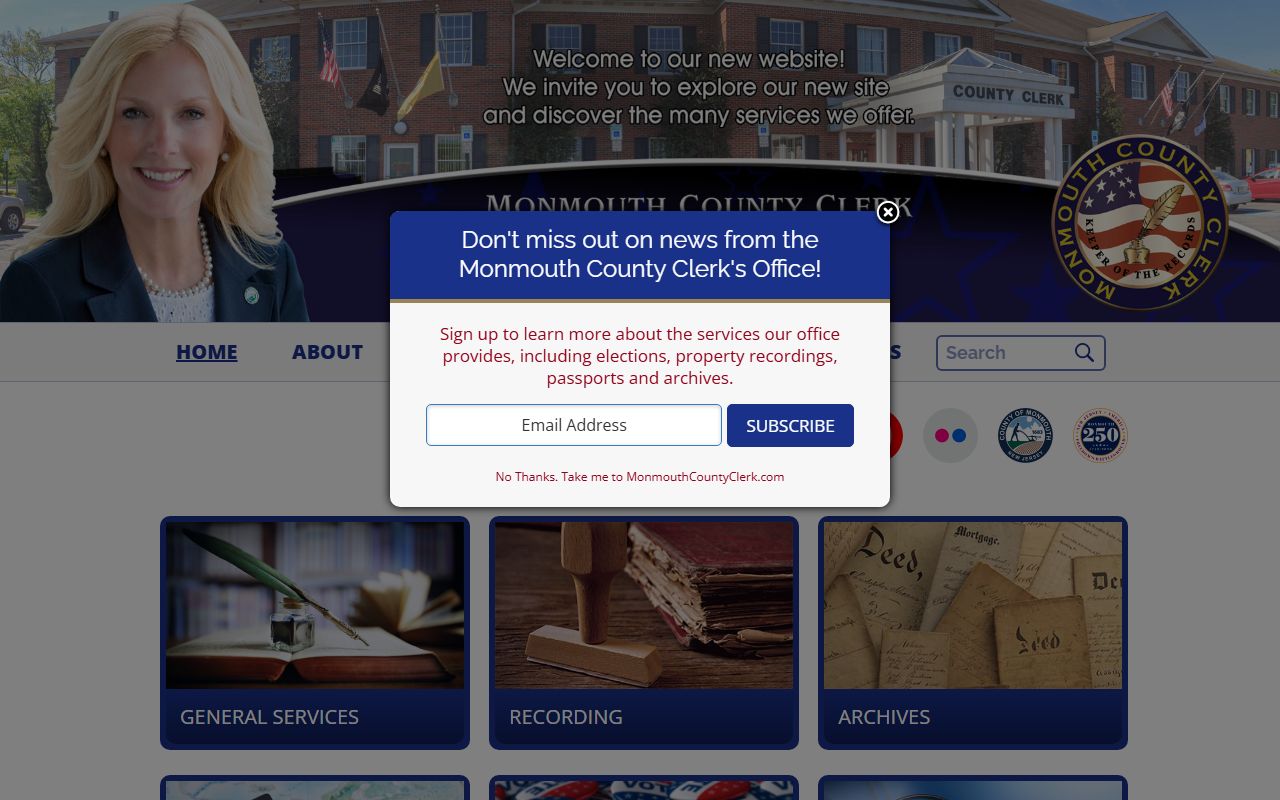
The clerk of court page explains how the Superior Court Clerk and the County Clerk split their duties.
Monmouth County Court Records Fees
Copy fees are low but vary by source. The judiciary charges per page for court record copies, with certification fees on top if you need a sealed or certified copy. The County Clerk charges a flat fee for a redaction request. The table below lists the fees found in official forms.
| Item | Amount |
|---|---|
| Court record copy, letter size | $0.05 per page |
| Court record copy, legal size | $0.07 per page |
| County Clerk redaction request | $10.00 per request |
| County Clerk copies (older redaction form) | $0.25 per page |
Certified and exemplified copies cost more and must be requested from the proper court office. An online index alone is not a certified record.
How to Interpret Monmouth County Court Records
Court records use shorthand that can confuse first-time readers. A charge is not the same as a conviction. A complaint or indictment only states an accusation. The disposition tells you the real outcome, such as dismissed, pled, or sentenced. Docket entries list events in order, like motions, orders, and hearings.
Watch the case prefix too. It points to the division, so a family matter, a civil suit, and a criminal case all read differently. When a record is unclear, the safest move is to call the court office that holds the file and confirm the current status.
Accuracy and Record Limitations
Online court and county records can lag behind the paper file. Updates take time, and some documents never go online at all. Treat an online result as a starting point, not the final word.
Note: Always confirm key details with the court or county office that holds the record before you rely on it for any legal or financial decision.
History of Monmouth County Courts
Monmouth County is one of New Jersey's historic counties, with Freehold as its long-standing county seat. The court complex at Monument Park has served as the civic and court center for generations. The county prosecutor role traces back nearly 200 years, to 1823, and Raymond S. Santiago is counted as the 30th fully confirmed county prosecutor.
The courthouse still hosts legal-community traditions, including the yearly Opening of Court Ceremony with the Monmouth Bar Association and Law Day events with judicial portrait unveilings. Courtroom 307 West on the third floor is a named public ceremony space. The county government homepage, shown below, links these offices in one place.
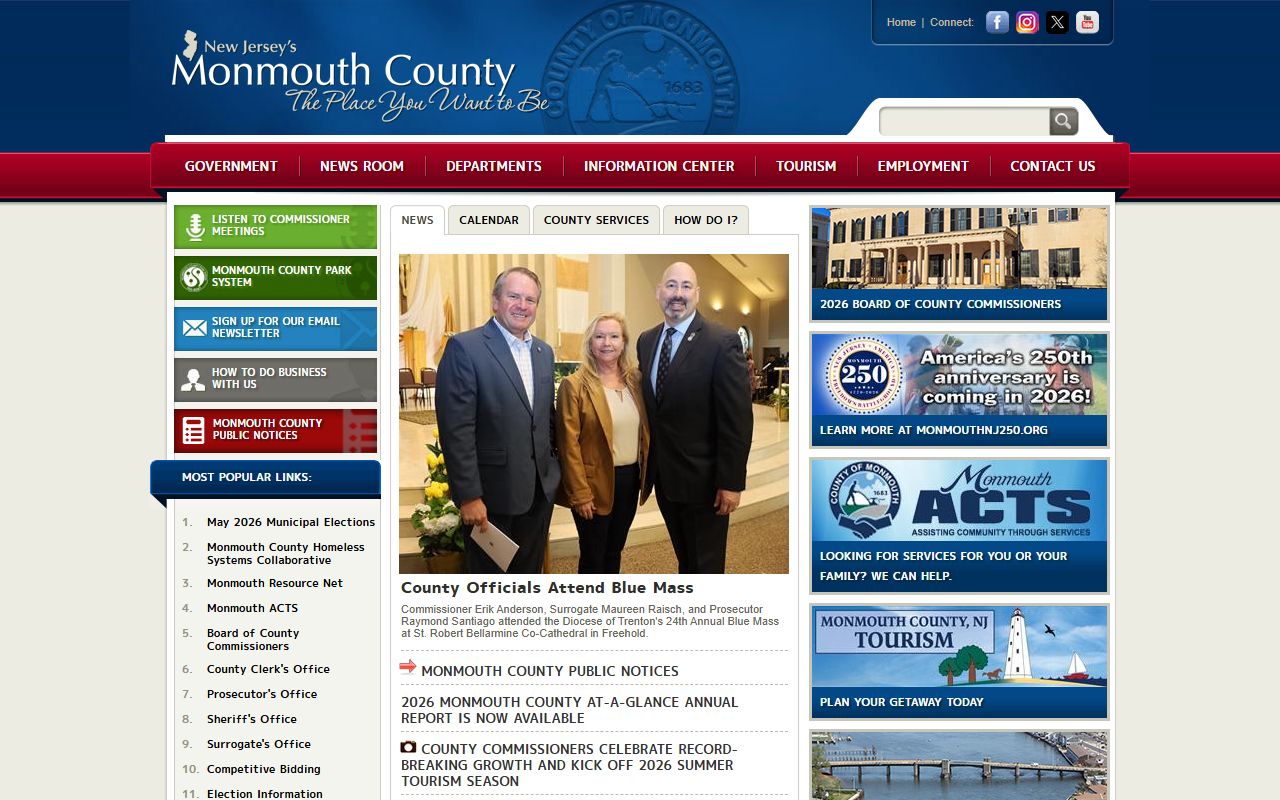
The same homepage points to the clerk, sheriff, surrogate, and prosecutor, which makes it a useful hub for county record access.
Frequently Asked Questions
How do I search Monmouth County Superior Court records?
Use New Jersey Courts' Find a Case tools or the direct civil and criminal case search portal. These are state judiciary records, not County Clerk records. If the portal does not show the case or document you need, file Judiciary Records Request Form CN 10200 with the docket number, case name, county, and division. More detail is on the court records page.
Are Monmouth County court records covered by OPRA?
No. The Government Records Council has said the judicial branch is not a public agency under OPRA. Court records follow court rules, mainly Rule 1:38, and judiciary request procedures. County government records, like property records or meeting minutes, do fall under OPRA. The public records page explains the difference.
How do I find someone in the Monmouth County jail?
Use the Sheriff's inmate search, which has First Name, Last Name, and Charge Agency fields. The Sheriff warns that misusing the information to threaten or harass someone may lead to criminal or civil liability. Full steps and visitation rules are on the inmate records page.
More answers are on the Monmouth County Court Records FAQ page.